How to Actually Remember What You Read (2026 Guide)
June 6, 2026 · Kamban
You finish a good book, or an article you meant to learn from, and think "I should remember this." Then you don't. A few weeks later you can barely recall the core idea, let alone the key points.
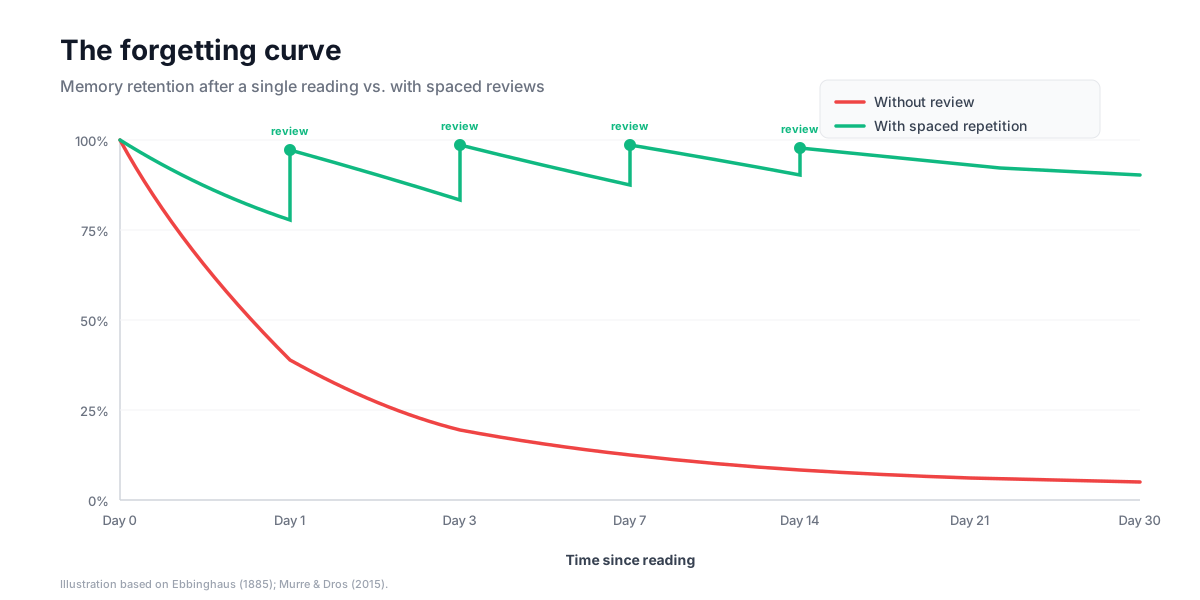
This is not a personal failing. It is how human memory works. Hermann Ebbinghaus, a German psychologist, described it in 1885 after running a series of experiments on himself. He found that memory retention drops sharply within the first hour after learning, then levels off into a slower decline over days and weeks. Researchers have been replicating his core findings ever since. A 2015 study by Murre and Dros closely matched Ebbinghaus's original 1885 data.
The practical result: if you read a lot, a large fraction of what you read today will be mostly gone within a day or two unless you do something about it. Not because you are bad at learning, and not because you need to memorize harder. Passive reading just does not build lasting memory by itself. You will not remember every book you finish, and no one does, but you can remember far more of the ones that matter.
The good news is that a handful of techniques genuinely work. They are not complicated, but they do require doing something different from what most readers do.
Why Most Reading Doesn't Stick
There are two common habits that feel productive but don't help much.
Re-reading. Going back to re-read the same material feels like learning. Research suggests it mostly isn't. You recognize the words, which creates a false sense of familiarity. Recognition and recall are different things. Recognition is easy. Recall -- being able to bring something back from memory without looking at it -- is the thing that matters.
Highlighting. Marking passages while you read is satisfying in the moment. But unless you do something with those highlights afterward, they just sit there. Most people never return to them. Readwise built an entire product around the insight that people highlight a lot and re-read their highlights very rarely.
Saving links. Every app in the read-it-later category is built around a version of this problem. You save something to read later. Later never comes. The link joins a pile of other links you also never opened. Your read-it-later list becomes a graveyard.
None of this means reading is pointless, or that your comprehension is the problem. It means the reading itself is the easy part. You can understand a book fully while you are reading it and still lose most of it within weeks. Strong reading comprehension in the moment does not guarantee recall later. The retention requires something else.
What Actually Works
1. Active Recall: Test Yourself Instead of Re-Reading
Active recall means trying to retrieve information from memory without looking at it. That's the whole idea. Instead of reviewing your notes, close the book and ask yourself: what did I just read? What was the main argument? What would I tell a friend?
This feels harder than re-reading, which is precisely why it works better. The effort of retrieval strengthens the memory trace, moving the idea out of fragile working memory toward durable long-term memory. Connecting what you read to your existing knowledge, a technique researchers call elaborative encoding, makes it stick harder still. Psychologists call the core effect the "testing effect" or "retrieval practice effect." The research on it is consistent going back decades.
Simple ways to do it:
- After finishing a chapter or article, write a short summary from memory (not from the text).
- Use flashcards or a spaced repetition app for specific facts you want to retain.
- Explain what you read to someone else, or write as if you are.
You do not need special software for basic active recall. A blank piece of paper works.
When to use it: Any time you want to remember specific arguments, facts, frameworks, or ideas from something you've read. Works for books, articles, courses, anything.
2. Spaced Repetition: The Most Efficient Way to Lock In Memory
Active recall tells you to test yourself. Spaced repetition tells you when.
The core insight: reviewing something right after you learn it is mostly wasted effort -- you already remember it. The more useful moment to review is just before you forget it. Spaced repetition systems schedule reviews at exactly those intervals: a bit later each time you get something right.
The SM-2 algorithm. The most widely used spaced repetition algorithm is SM-2, developed by Piotr Wozniak and first published in his 1987 master's thesis. It works like this:
- Each item you review has an "ease factor" (EF), which starts at 2.5 and adjusts based on how well you recalled it.
- After your first successful review, the item comes back after 1 day. After your second, 6 days. After that, the next interval is the previous interval multiplied by the ease factor -- so intervals grow exponentially when you keep recalling something correctly.
- You grade each recall on a 0-5 scale. Grade 5 means perfect recall; grades below 3 reset the item back to the beginning. The ease factor adjusts after each review based on your grade, so items you find hard come back sooner and items you find easy come back less often.
- BeeMind simplifies this into three buttons: Hard, Good, and Easy.
This adaptive scheduling is what separates spaced repetition from just "reviewing things periodically." The algorithm responds to your actual recall performance, not a fixed calendar.
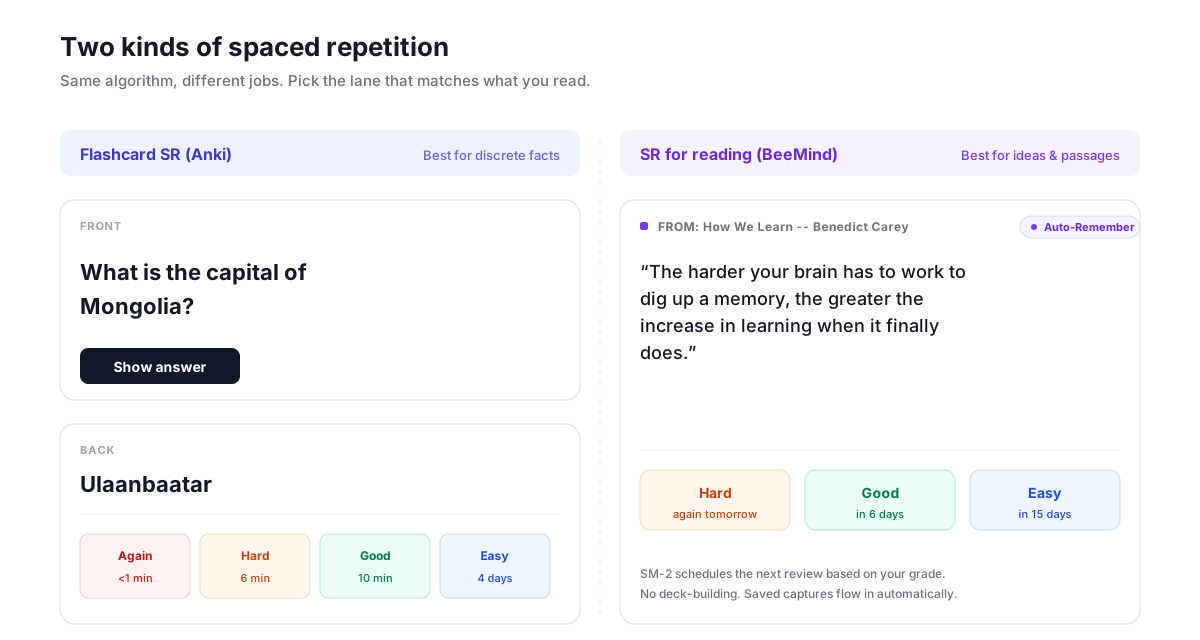
Two different jobs, two different tools. Spaced repetition software falls into two distinct categories, and understanding the difference matters before you pick a tool.
Flashcard SR (Anki and similar): You create or import flashcard decks -- one question, one answer. Anki, which is free and open-source, is the most established tool in this category. It is powerful and has an enormous library of shared decks. It is best for learning discrete, testable facts: vocabulary in a foreign language, medical terminology, chemistry definitions, historical dates. You write the cards, you review the cards, the algorithm schedules them. The deck is the unit of learning.
SR for things you read: A different job. Here you are not drilling flashcard facts. You are capturing passages, ideas, and quotes from your actual reading, and you want the system to resurface them later so they stay active. Readwise's Daily Review does this for highlights you make inside their reading app. This category is newer, and the tools that do it are fewer.
The distinction matters because using Anki for general reading retention is a significant amount of work. You have to create every card yourself. If you read a lot across many topics, this overhead adds up fast. Many people start an Anki deck for their reading, create cards for a week, then abandon it. The problem was not Anki -- it was that flashcard SR is optimized for a different job.
3. Note-Taking: Useful If You Actually Return to Your Notes
When you take notes while you read, you translate ideas into your own words, which is a form of active processing. That part is good. The problem is that most notes are never opened again.
Research on this is pretty clear: the average person takes notes, files them somewhere, and rarely retrieves them. If your notes become a second archive you never revisit, you have just moved the problem.
Notes that work tend to share a few traits:
- They are short summaries in your own words, not copied quotes. Jot the key points and the core idea, not every sentence.
- They connect the idea to something you already know or are working on.
- They have a reason to be retrieved -- a project, a question, a draft you are writing.
Whether you write notes by hand in the margins or make notes digitally, the format matters less than whether you review your notes later. Marginal notes and a page number scribbled inside the cover are fine if you actually go back to them. Tools like Obsidian, Notion, Evernote, and Logseq are built for organizing notes and annotations. They are excellent at that job. They do not, on their own, resurface your old notes for you. That resurface step is where most note systems quietly fail.
When to use it: When you are reading for a specific project or question and want a record you will actually use. Not as a general "capture everything" habit unless you have a reliable retrieval system attached.
4. Teaching and Writing: Explaining Things Forces You to Know Them
The physicist Richard Feynman had a useful heuristic: if you cannot explain something in plain terms, you don't understand it yet. Trying to explain forces you to find the gaps.
You do not need to teach anyone. Write a short paragraph explaining the idea as if you're describing it to a smart friend who hasn't read what you just read. Try to summarize a chapter in three sentences. Write a Twitter-length take on the book's main argument.
This process of compression and translation carries real cognitive load, in a good way. It tells you what you actually understood versus what you only skimmed.
When to use it: For bigger ideas, frameworks, or books where you want to genuinely internalize the argument, not just remember individual facts.
How to Combine These Methods
You don't need all four for every piece of reading. The right combination depends on what you read and why.
A quick summary habit for casual reading
For casual reading -- articles, newsletters, things you find interesting -- a quick active recall summary (write two sentences about what stuck) is usually enough. The same goes for an audiobook you half-listened to on a commute, or a book you only had time to skim. When you finish a book like that, a two-minute recall of what stuck beats nothing. If you find something you want to remember long-term, capture a specific passage and put it in a spaced repetition queue.
Nonfiction books you want to revisit
For nonfiction books you are reading seriously -- for a project, for learning a skill -- combine note-taking (your own words, short) with spaced repetition for the ideas you want to retain. If you read James Clear's Atomic Habits and actually want to apply it, capturing the three or four core ideas and revisiting them over the following weeks beats highlighting the whole book and never opening it again.
For studying or exam preparation, structured flashcard SR (Anki) is genuinely hard to beat for discrete facts.
The common mistake is applying the most elaborate system to every book and article, then abandoning it because the overhead is too high.
A Tool That Handles SR Automatically for Your Reading (BeeMind)
Disclosure: this is our product. We include it here because it fits directly in the "SR for things you read" lane described above. We have tried to give honest guidance on the other tools in this post.
BeeMind is built for people who save a lot and remember too little. It is a quick-capture second brain for Mac, iPhone, and iPad.
The capture is one keystroke: Control+Command+B in any Mac app, the macOS Services right-click menu, or the iOS share sheet. Save a passage, a quote, a link, an article, a PDF -- whatever caught your attention. No folders, no tags, no organizing step.
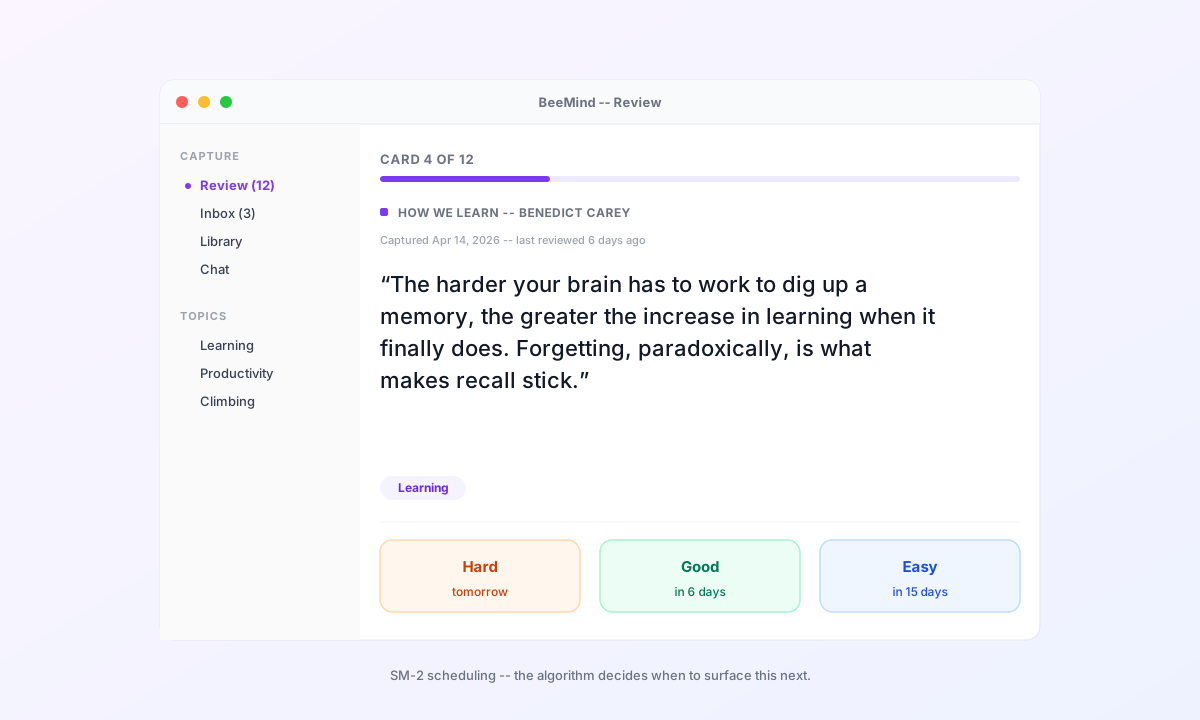
The spaced repetition is built in. Saved captures go into an SR queue automatically. You mark each one Hard, Good, or Easy, and the SM-2 algorithm schedules when it comes back. There's also an Auto-Remember feature that promotes new captures by topic -- you describe what you care about in plain English, and BeeMind brings relevant captures forward for review.
When you want to find something you saved, you don't search through folders. You ask. BeeMind's chat function answers questions about your entire library -- "what did I save about pricing strategy?" -- and gives you answers with citations back to the specific captures they came from.
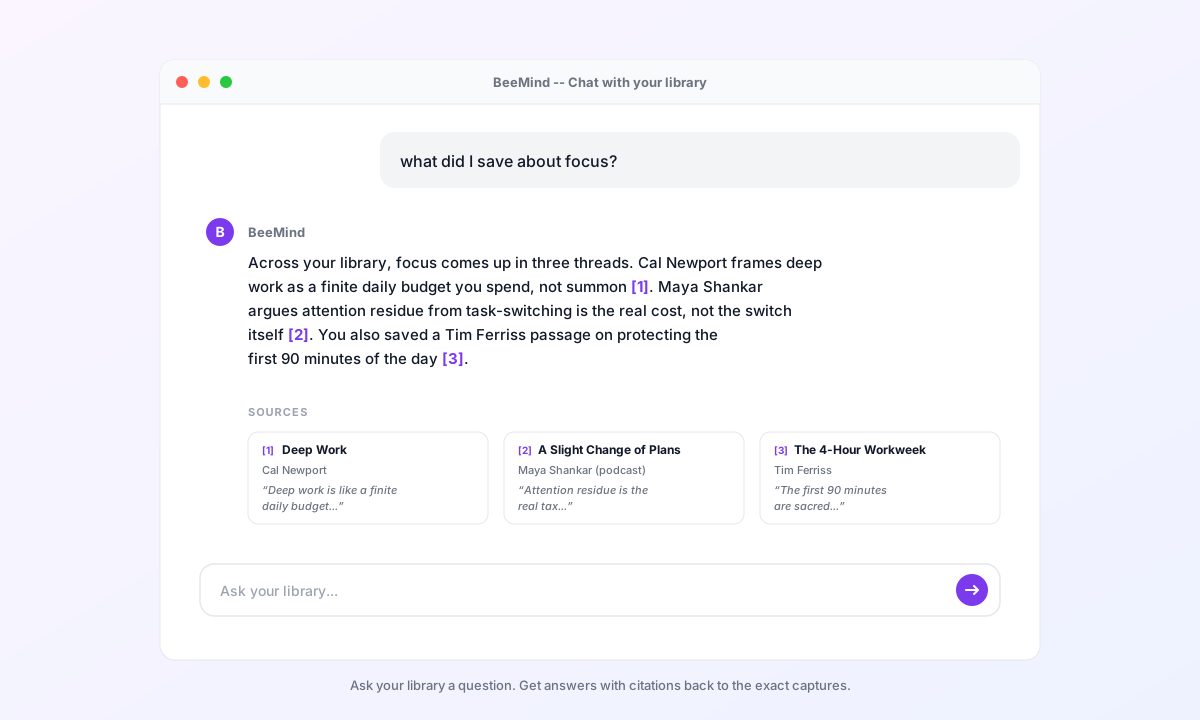
BeeMind is newer than Readwise and Anki. It does not have years of user reviews or a large community deck library. What it has is a different focus: one-keystroke capture from your daily reading, SR for the things you saved, and a chat interface over your whole library.
It runs on Mac, iPhone, and iPad. Sync is via iCloud. For privacy: you can bring your own API key (Claude, GPT, Gemini) on the free tier, or use the built-in model on Pro ($7/mo). A fully local option exists -- both the chat model and the indexing model can run on-device via a local LLM, so nothing leaves your Mac -- though this is opt-in and the app itself notes that cloud indexing currently gives better accuracy.
If you're already a Setapp subscriber, BeeMind is included at no extra cost. If not, the free tier with your own API key is a real option, or Pro is $7/mo.
The other tool worth mentioning in this lane is Readwise. Its Daily Review resurfaces highlights from articles you have read inside Readwise Reader, using spaced repetition logic. It is well-established, more expensive ($9.99/mo billed annually for the full product), and excellent if you want deep reading annotations and integrations with Obsidian or Notion. See the 10 best read-it-later apps post for a fuller comparison.
If you came here from the Pocket shutdown and are rebuilding a reading workflow, the Pocket alternatives guide covers the landscape with current pricing.
The Honest Summary
Re-reading and highlighting feel productive and mostly aren't. Active recall and spaced repetition have the strongest research backing for long-term retention. Note-taking helps when you have a reason to return to your notes. Writing or explaining locks in understanding when facts alone aren't the goal.
For most readers, the biggest lever is the simplest: do something with what you just read before you move on. A two-sentence summary written from memory beats re-reading the same passage three times.
Spaced repetition is worth adding if you read enough that you want a system -- not just for exam prep but for the ideas and passages you genuinely want to keep. The choice of tool depends on what you're learning: flashcard SR (Anki) for discrete facts, capture-and-resurface SR (Readwise, BeeMind) for the things you read day to day.
Pick the method that fits your actual reading habits, not the most elaborate system available.
You don't need to remember everything you read. The goal is to keep the ideas worth keeping. The habits above help you remember books and articles long after you have finished reading them, and the best reading routine is the simple one you will actually repeat. There is no prize for rereading the same chapter five times.
Frequently Asked Questions
Does spaced repetition work for articles and general reading?
Yes, with one caveat about how you use it. Spaced repetition is most effective when it resurfaces specific, retrievable items -- a quote, a passage, a key idea -- not whole articles. The challenge with traditional flashcard tools like Anki is that you have to manually create a card for every item you want to remember, which is a lot of overhead for general reading. Tools built specifically for reading retention (Readwise's Daily Review, BeeMind's SR queue) handle this more automatically by working directly with what you've saved. The research on spaced repetition itself is consistent: reviewing information at expanding intervals produces significantly better long-term retention than massed review or passive re-reading.
What's the best way to remember what you read?
The most research-supported approach combines active recall and spaced repetition. After reading, close the article or book and write a short summary from memory -- this retrieval effort strengthens the memory trace more than re-reading does. For material you want to retain long-term, put key ideas or passages into a spaced repetition system that resurfaces them at gradually increasing intervals. For deeper understanding (not just retention of facts), the Feynman technique -- writing an explanation in plain terms, then finding where you're fuzzy -- is also effective. The right combination depends on why you're reading: casual reading needs less structure than reading for a project or skill.
What is the SM-2 algorithm?
SM-2 is a spaced repetition scheduling algorithm developed by Piotr Wozniak in 1987, published in his master's thesis on optimizing learning. It is the algorithm behind Anki and many other spaced repetition tools (including BeeMind's built-in SR feature).
It works by giving each item you review an "ease factor" (EF), which starts at 2.5. After a correct recall, the next review interval grows: 1 day after the first success, 6 days after the second, then the previous interval multiplied by the ease factor for subsequent reviews. If you recall something easily, the ease factor goes up and intervals grow faster. If you struggle, the ease factor goes down and the item comes back sooner. Getting something wrong (scoring below 3 on a 0-5 scale) resets the item to the beginning. This adaptive scheduling means the system focuses your review time on what you are most likely to forget, rather than having you re-review things you already know well.
Is spaced repetition the same as Anki?
Anki is a specific app that uses spaced repetition -- it is not the same thing as spaced repetition itself. Spaced repetition is the broader method: reviewing material at increasing intervals timed to hit just before you would forget it. Anki is the most widely used tool for flashcard-based spaced repetition, particularly for students learning discrete facts (vocabulary, medical terms, historical dates). There are other ways to apply spaced repetition, including tools designed for resurfacing saved articles and passages rather than flashcard decks. Anki is free and open-source; it has a large shared deck library; and its interface has stayed fairly utilitarian for a long time.
Can I remember more without using flashcards?
Yes. Flashcards and spaced repetition apps are useful but not the only path. Active recall without any app -- writing summaries from memory, explaining ideas out loud, teaching someone else -- produces real retention gains. The Feynman technique (explain it simply, find where you're stuck) helps with understanding as much as memorization. For reading specifically, taking the time to write two or three sentences about what stuck before you move on is one of the most effective, lowest-overhead habits you can build. Flashcards become more useful the more specific and testable the material is. For general ideas and arguments from books and articles, active recall through writing or conversation often works better and with less overhead.